
Villa Streetscape
Forest-themed villa streetscape
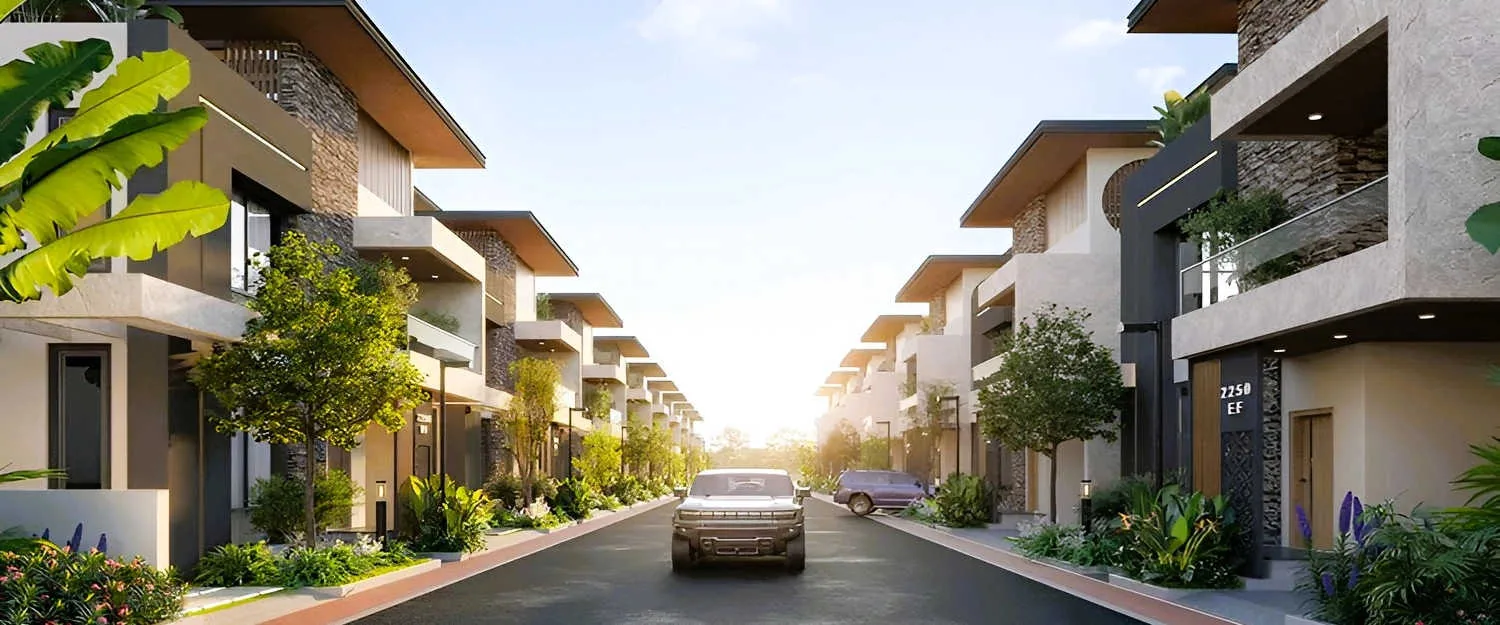
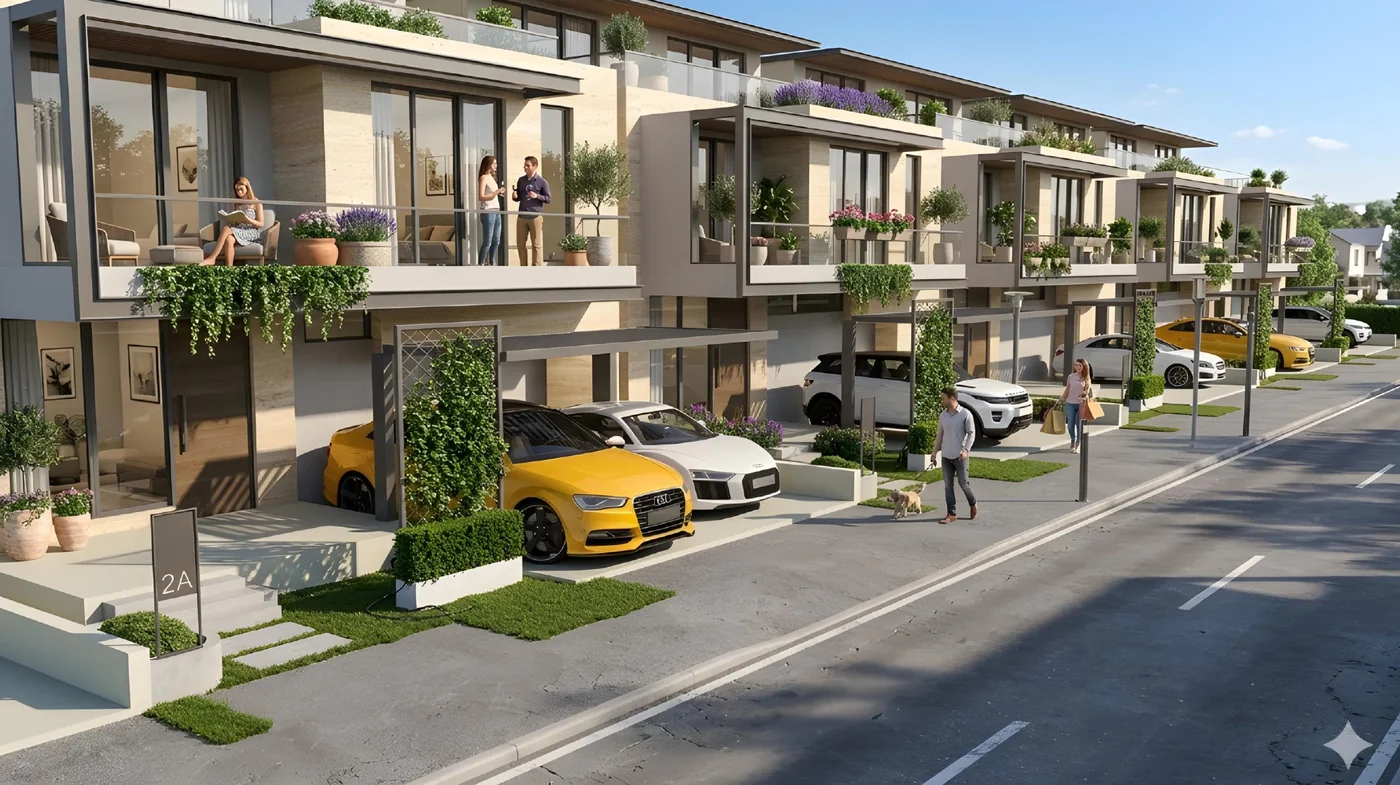
The streetscape establishes the address-grade: brick-clad facades arranged along a tree-lined internal road, with every neighbour's facade contributing to the whole - the biggest qualitative difference between a designed villa community and a plotted layout. Nambiar District 25 is useful when buyers are reading images for practical signals: light, approach, amenity scale, landscape maturity, and what still needs official confirmation.
Aerial View
Aerial of the 50.4-acre township
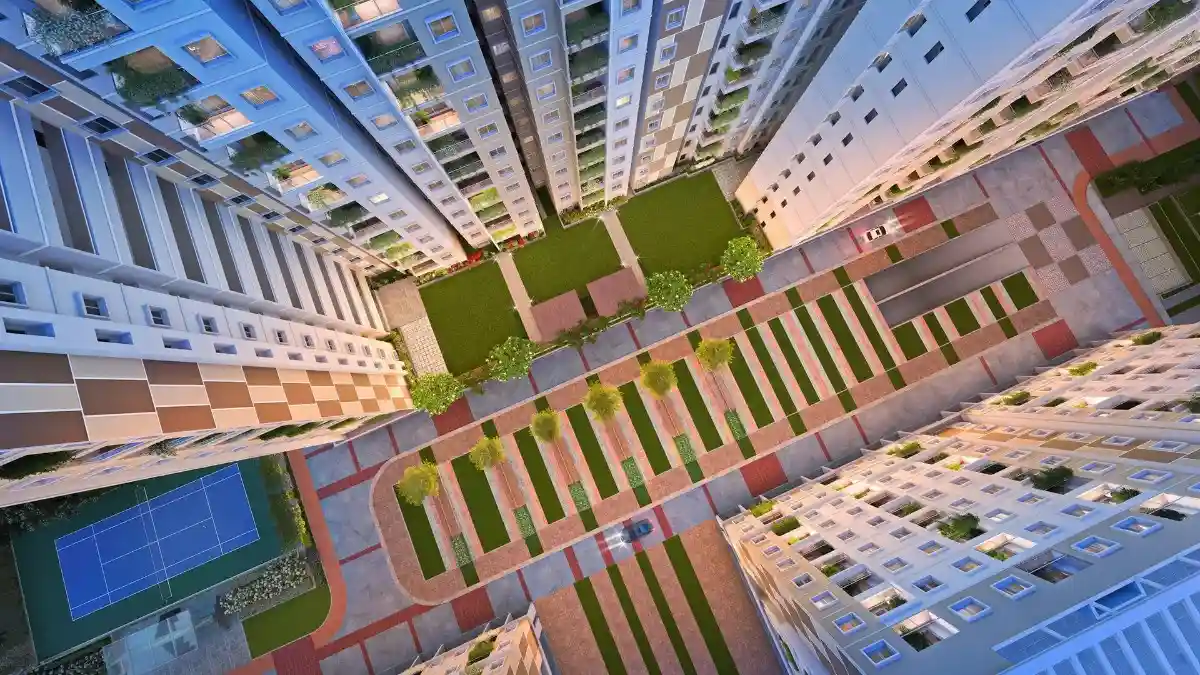
The aerial is the most diagnostic image, compressing the villa-to-open-space ratio, the amenity placement and the boundary treatment into a single frame; here it confirms the low-density thesis, with roughly half the land kept open.
Serene Facade
The Serene facade theme
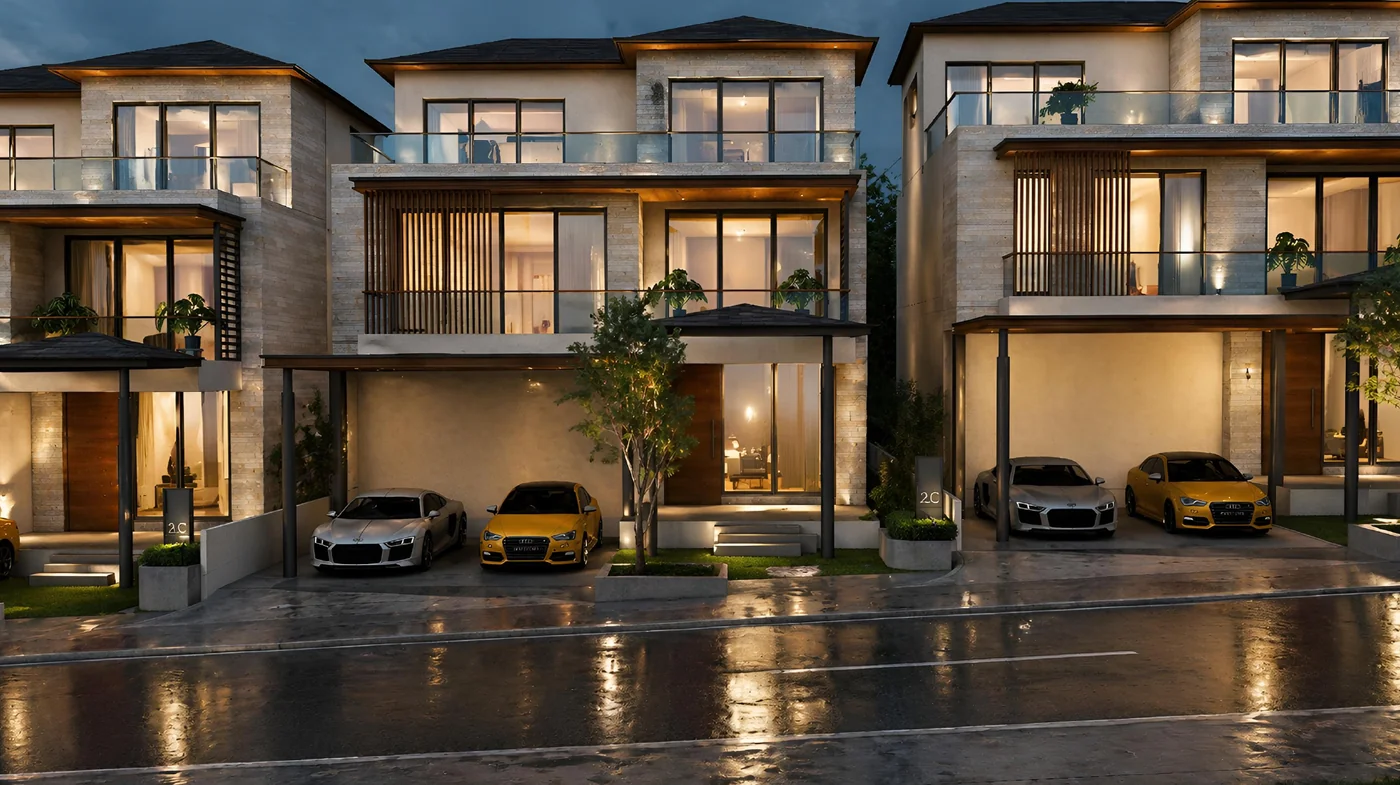
The facade render shows the Serene theme's material honesty - brick as brick, stone as stone, concrete as concrete - shown as themselves rather than disguised, which is what gives the architecture its timeless quality. Three facade themes (Serene, Mellow, Halcyon) work the same palette into distinct expressions.
Central Clubhouse
The central clubhouse
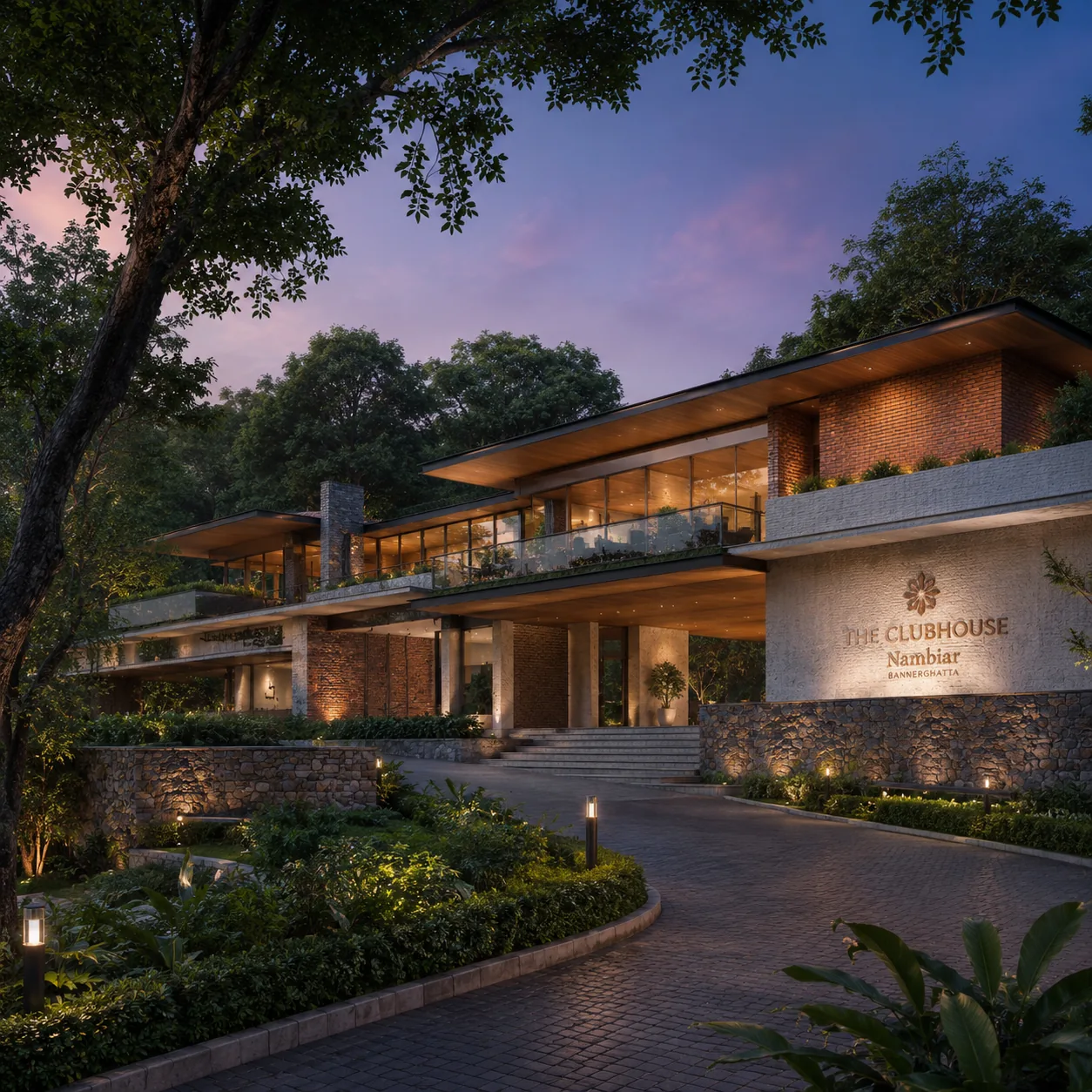
The clubhouse extends the villa material language at community scale - textured concrete, natural-stone plinths and forest-canopy landscaping - anchoring the amenity precinct at the heart of Phase 1.
Villa Interior
Ground-floor living interior
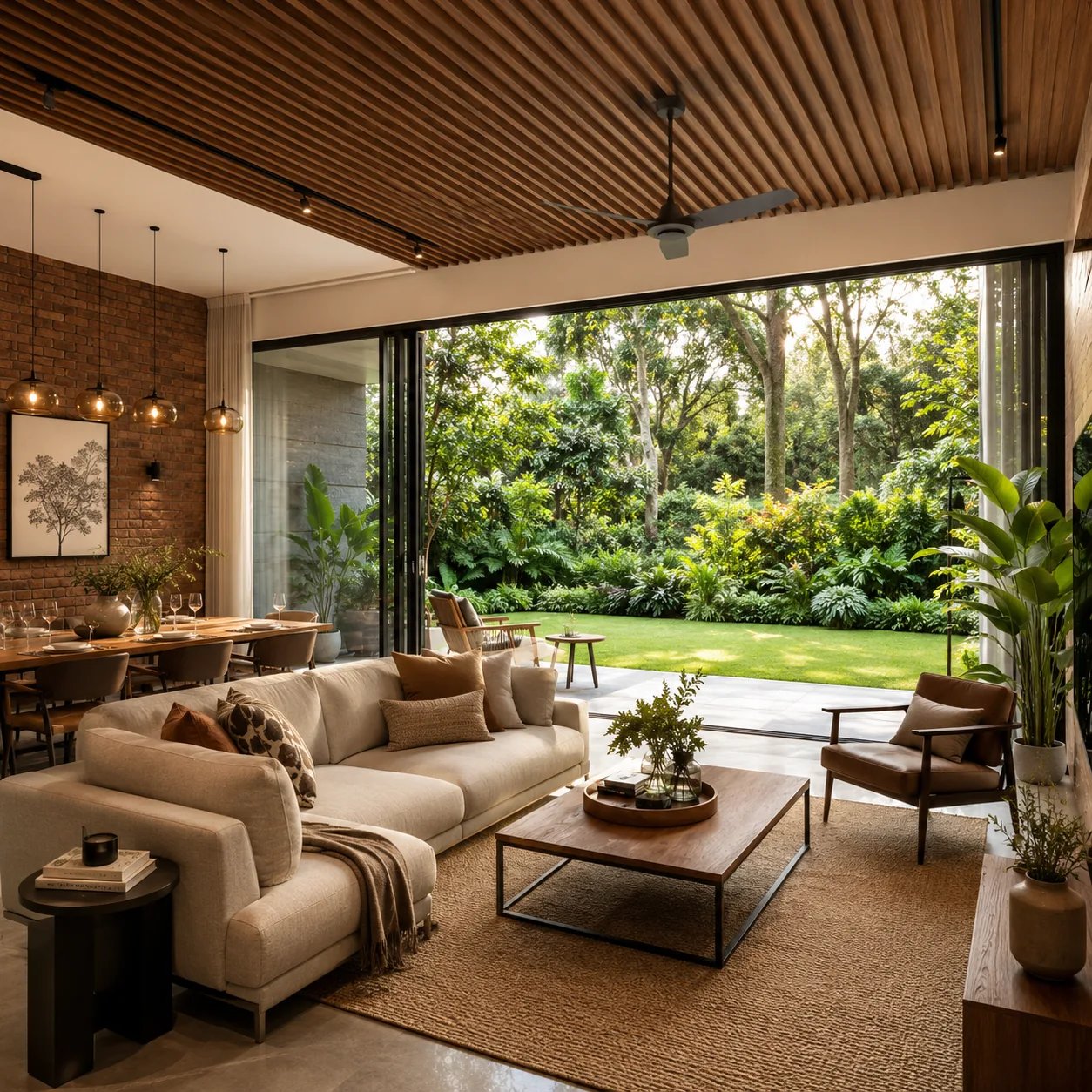
The villa interior shows the connected open family area with garden-facing glazing - the ground floor as the social heart of the home, with living, dining and family flowing into the private garden envelope.
Landscaped Greens
Central landscaped greens
The landscaped greens show the open-space network that distributes amenities across the community rather than concentrating them in one block - trails connecting clusters to the clubhouse without forcing residents onto vehicle roads.
Light, Material and Mood
A forest-edge community across the day
If one quality defines the imagined Nambiar Bannerghatta gallery, it is the play of light on natural material. Morning light rakes across textured brick and fair-faced concrete, picking out their grain; midday sun is filtered by the canopy into dappled shade on the roads and lawns; and evening light warms the timber entrances and catches the glass railings. Because the materials are shown as themselves, the facades change character through the day in a way rendered or painted surfaces never do. The mood is calm, grounded and unhurried - the architectural equivalent of the forest-edge setting.
A forest-edge community also looks different across Bengaluru's seasons: lush planting and richer facade tones in the monsoon, shaded canopy and a living-room of central greens in the dry months, and year-round birdsong from the national-park buffer. As the landscape matures over the years after handover, these images will only grow stronger. Read the gallery alongside the floor plans and the master plan for the clearest picture of life at Nambiar Bannerghatta.
The Design Intent
Nambiar Bannerghatta through the lens of design
Every render in the Nambiar Bannerghatta gallery is rooted in a single architectural brief: "Nature / Eco" — a seamless fusion between built form and the surrounding forest, where architecture dissolves into the forest, walls breathe, roofs bloom and light is softened by trees. The renders work hard to convey that intent visually. Exposed brick is left to express its grain rather than rendered flat; fair-faced concrete shows its formwork; natural-stone plinths ground each villa to its plot; weathered-steel and dark-metal accents add crispness at openings and railings; and timber warms the entrances and soffits. The discipline running through every image is material honesty — brick as brick, stone as stone, concrete as concrete — shown as themselves rather than disguised behind paint and plaster.
That single discipline is what gives the architecture its timeless, nature-rooted quality. Rendered or painted facades age toward sameness; honest materials weather into character, gathering texture and patina over the years rather than peeling and chipping. For a buyer reading the gallery, this is the most important signal: the renders are not just selling a look but a way of building, one that holds its quality across the decades a villa will be lived in. The Serene, Mellow and Halcyon facade themes each work the same palette into a distinct expression, so the streetscape gathers variety from street to street while reading as a coherent designed whole.
The renders also reflect a master-planning discipline. With achieved residential efficiency held to roughly 49%, more than half the site is given over to roads, open space, landscape and amenity infrastructure. That low-density geometry shows up in every frame: wider streets, deeper setbacks, planted verges, and a generous green envelope around every home. The aerial render is the most diagnostic image because it shows the green-to-built ratio at a glance — the villa roofs nestled among the canopy rather than crowding it out.
Interior Space Planning
Nambiar Bannerghatta villa interior renders read
The villa-interior renders show ground floors planned around a connected open family area, where living, dining and family flow into one another and out through garden-facing glazing onto the private backyard. Living zones occupy the northern part of the plot, the kitchen and master suite are oriented for light and ventilation, and the sightline through the home opens directly to the garden envelope. That planning logic — social heart on the ground, private retreat on the first floor, flexible room and terrace on the second — is consistent across all four villa formats, and the renders are calibrated to convey it.
Look closely at the interior renders and the material palette continues indoors. Natural textures and warm finishes carry the villa's outdoor language inside — exposed brick reveals at accent walls, stone in wet zones, timber on stair treads and joinery, fair-faced concrete on selected ceilings — providing a strong architectural base that complements both contemporary and warm, natural interior schemes. Glass railings, generous glazing and a clear sightline through the home pull greenery in from every aspect, so the interior renders look out onto landscape rather than walls. The upper-floor renders show the principal bedrooms set away from daytime activity below, with the second-floor flexible room — study, family lounge, home theatre or guest suite — opening directly onto the private terrace.
For prospective buyers, the most useful way to read the interior renders is to imagine a day at home. Morning light rakes across the kitchen island and the dining table through the eastern glazing; the connected family area becomes a single working zone for school runs, breakfast and work calls; the garden door opens onto a private outdoor extension of the living space. By evening the upper floors become the family retreat — bedrooms quiet on the first, the terrace open to the sky on the second. The renders deliberately frame these moments because they are how the home will actually be lived in, not how it will be photographed for a brochure.
Podium & Common Areas
Clubhouse, central greens and the amenity precinct
The clubhouse renders show the community's social anchor at full scale. A double-height entrance framed in stone and timber opens onto the central greens, textured concrete walls and natural-stone plinths line the lounge and indoor-games zone, and the multipurpose hall is planned to spill out onto landscaped terraces. The renders show the temperature-controlled pool set in a landscaped deck, the gymnasium and wellness studio framed by glazing that looks out into the greens, and a separate kids' pool tucked alongside. What the renders deliberately avoid is a single concentrated amenity block: instead, the clubhouse functions as a hub from which trails radiate out across the open space, connecting homes to sports courts, play areas and gathering lawns without crossing the main vehicle roads.
The central greens renders capture how the amenity precinct extends into the open landscape. Native and canopy trees, natural-stone edges and textured ground treatments carry the villas' material language out into the commons — so built form and landscape read as one rather than as two competing palettes. Gathering lawns, an amphitheatre and senior-citizen seating courts give the open space programmed social anchors, while pet-friendly green pockets and children's play areas distribute family-scale amenities across the layout rather than concentrating them in one corner. The southern boundary opens onto the protected national-park buffer, so the designed landscape flows seamlessly into real forest at the community's edge.
The sports and wellness renders complete the picture. Outdoor sports courts — tennis, basketball, badminton — sit among the trees rather than on a paved plaza; jogging and cycling trails loop through the low-density layout; and a yoga and meditation deck and a reflexology walk give the wellness offer a quiet, green-facing setting. The senior-citizen seating courts and shaded greens for daily strolls round out a community where everyday life happens outdoors, among the planting and the forest-edge greenery, exactly as the "Nature / Eco" concept sets out to deliver.
Nambiar Bannerghatta Gallery FAQs
What does the Nambiar Bannerghatta gallery show?
Visual impressions of the brick-and-stone villa streetscapes, the aerial master plan, the three facade themes (Serene, Mellow, Halcyon), the central clubhouse, a representative villa interior, and the landscaped central greens that thread through the low-density layout.
Are the Nambiar Bannerghatta gallery images final?
As a pre-launch community, the gallery is best read as artist's impression drawn from the design brief. Final material and finish specifications are confirmed against the RERA-approved specification sheet; all images shown are indicative.
What are the three facade themes?
Serene is the foundational theme - textured concrete, brick planters, wooden finishes, dark-metal detailing, glazing and glass railings. Mellow is a warmer reading leaning on stone cladding. Halcyon is the most expressive, working the full material kit into a sculptural elevation.
When will real construction photos be available?
As a pre-launch project at the master-planning and approvals stage, real images of the entrance, the first villa rows, the clubhouse and the maturing landscape will fill the gallery over the construction horizon. Until then, the descriptions convey the designed intent.
Can I visit the site to see it in person?
Yes - site and experience-centre visits can be arranged through the contact form. The experience centre is the first built expression of the design and the best way to assess the material palette and the forest-edge setting first-hand.
What material palette do the villas use?
Exposed brick and stone, fair-faced and exposed concrete, natural-stone plinths and retaining walls, weathered-steel and dark-metal accents, timber finishes and glazing - shown as themselves rather than disguised, which gives the architecture its timeless, nature-rooted quality.